
EPILOGUE
EPILOGUE: THE ROAD AHEAD
Murrow said in his famous quote about television, that television should teach, illuminate and inspire…

“This instrument can teach, it can illuminate; yes, and it can even inspire.  But it can do so only to the extent that humans are determined to use it to those ends.  Otherwise it is merely wires and lights in a box.  There is a great and perhaps decisive battle to be fought against ignorance, intolerance and indifference.  This weapon of television could be useful.”

But few know the next and last paragraph of this famous speech when he spoke more about the weapon of television…

“Stonewall Jackson, who knew something about the use of weapons, is reported to have said, ‘When war comes, you must draw the sword and throw away the scabbard.’  The trouble with television is that it is rusting in the scabbard during a battle for survival.”

Don’t let this powerful weapon of broadcast journalism rust in its scabbard.  Use television for what Murrow intended—to teach, illuminate and inspire.

I hope by now that you can’t help but feel a bit of optimism and empowerment about the broadcast journalism industry.  It might be too late for the national networks and the national cable networks whose injuries are mostly self-inflicted.  I hope not.  I hope it’s not too late for local television.  I hope you understand that it’s time for solutions over complaints.  It’s time to take action instead of complaining.  I hope you understand how you must be armed with a newfound faith, idealism, and insight.  I hope you are willing to make these concepts practical.  I hope you are intent on taking action and inspiring hope within yourself and others to take action with you.  I hope you are a little more optimistic and empowered to take part in the necessary changes to bring salvation, revival and reform to broadcast journalism.  Remember, as Steinbeck said, because journalism is “the product of so many men, it is the purest thing we have.”

But I also hope you are realistic in your individual efforts.  It can be very discouraging when you understand the difficulties that lie ahead.  As for myself, I am nearing the end of a long career that started in 1978.  I feel like Moses who, after wandering over 40 years in the wilderness, stood at the edge of the Jordan River and was only allowed to look over at the Promised Land never being able to enter into it before he died.  I may not see the effects the gospel of journalism might have on our industry during my career or even my life.  But I hope that’s not your story.  I implore you to become a disciple, or prophet who proclaims the gospel of journalism.  Do you understand the responsibility, the awesomeness, and the almost holy function of journalism?  Are you ready to adopt new values and stick to them?  Are you ready for the persecution that comes with the idealism of journalism?  Journalism needs the kind of prophets that will revive it and start our craft on an ascent once again.  If you can’t be a prophet, look for ways you can rally behind a prophet and support the efforts of someone with the abilities to become a barbarian or builder/explorer that will help shape, build, expand and preach the gospel of journalism.  Whatever you do, don’t let our industry continue to wander in the wilderness.  Please choose to spread the seeds of the good news of journalism.  Dare to cross the river and get to the Promised Land.  Don’t get discouraged.  Look for little victories that add up to great victories.  With these victories, I believe strongly that you will reap a great harvest from the seeds you sow.  People will gravitate to you because—thanks to your commitment to journalism—you will show a level of self-esteem about yourself that is both bulletproof and contagious.  I really think that if we return to the gospel of journalism, we can bring about salvation, revival and reform and make the industry of broadcast journalism great once again.  The journey will be fruitful because, as we struggle along this road to greatness, we will enrich our own lives and our democracy, and we will protect and defend our democracy and our freedoms.
I end this book the way I started it—with a challenge to choose the right path.  Think of yourself for a moment as if you just arrived at a point where the road forks and you must choose a way without knowing where each road leads.  Robert Frost’s poem “The Road Not Taken” tells of a traveler who stood long and looked as far as he could see down both roads.  The traveler thinks he might choose the path less traveled that is “grassy and wanted wear.” He also thinks he might save the second path for another day, but realizes that “knowing how way leads on to way, I doubted if I should ever come back.”  Here’s the last stanza:
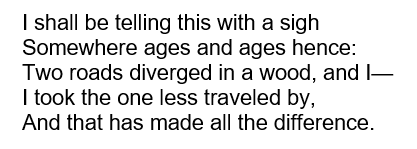
I hope choosing the right path that “wanted wear” makes a difference in your life and career.